
OPSQUILL STUDIO Debate
Should Trading AI Control Its Own Risk?
Listen here without leaving Opsquill Studio.
Select Play recording to load the audio securely.
Should trading AI operate within independently enforced risk limits, or could greater adaptability lead to better decisions? This Debate examines competing engineering philosophies, accountability, system complexity, and the boundaries of AI autonomy.
Introduction
Imagine an AI trading system that identifies an opportunity with exceptional confidence. It has analyzed the information, recognized a pattern, and reached a convincing conclusion.
Should it also be allowed to decide how much risk to take?
This Opsquill Studio Debate explores two competing approaches to intelligent-system engineering.
One position argues that intelligence, risk authorization, and execution must remain independently controlled. The other questions whether rigid separation introduces complexity, delays, and missed opportunities that more integrated, adaptive systems might avoid.
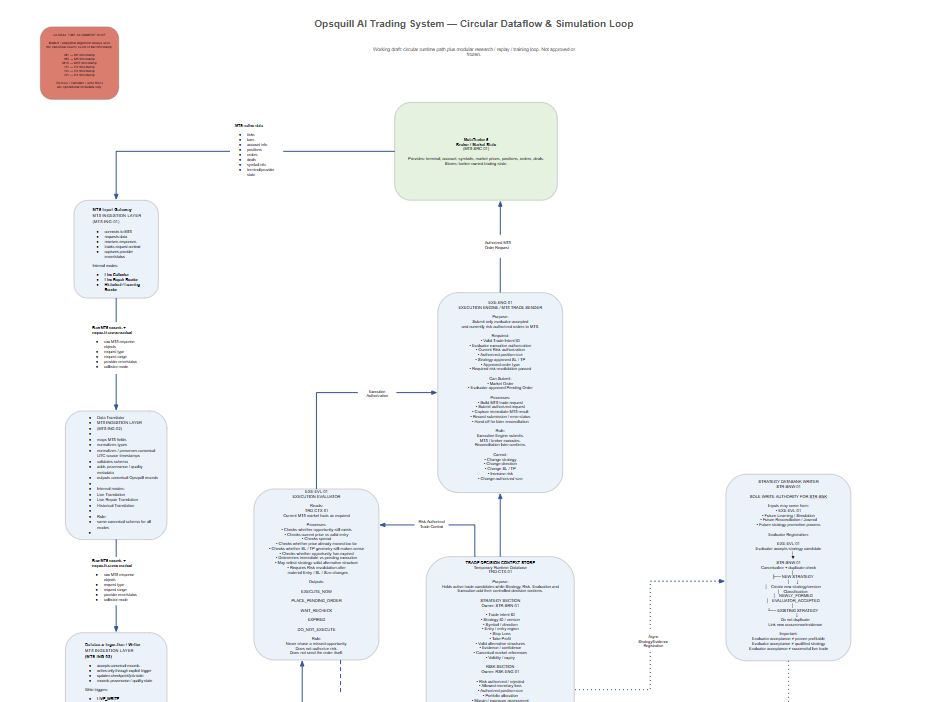
Inspired by the Studio Note Building Opsquill One Block at a Time, the debate examines how intelligence and authority should relate—and whether trustworthy automation depends more on strict boundaries, adaptive capability, or demonstrated system behavior.
The underlying Opsquill architecture remains a proposed development direction, not a validated or operational trading system.
What You Will Hear
Two competing perspectives on how intelligent trading systems should balance adaptability with independent control.
The intended debate examines whether AI should remain a decision adviser operating within fixed authority boundaries, or whether carefully constrained adaptive systems could be trusted with greater operational flexibility.
Central questions include whether deterministic safeguards are sufficient, whether strict modularity creates unnecessary complexity, how changing market conditions affect risk decisions, and what evidence would justify increasing an intelligent system's authority.
Neither perspective is assumed to be universally correct. The emphasis is on the trade-offs between accountability, responsiveness, complexity, and measurable reliability.
Production Credits
Produced by Opsquill Studio.
AI-generated audio debate using Google NotebookLM synthetic hosts.
Based on the Opsquill Studio Note Building Opsquill One Block at a Time: Designing a Trading System That Refuses to Guess.
Original project concept, source material, and editorial direction: Opsquill Studio.
The discussion presents contrasting conceptual engineering perspectives. It is not financial advice and does not establish that the proposed Opsquill trading system has been implemented, validated, or authorized for live trading.
Continue Exploring
Listen
The Blind Spots of Modular Trading Architecture
Does dividing an intelligent trading system into specialized components actually make it safer? This Critique examines the limitations of modular design, deterministic safeguards, system-wide reliability, and the potential costs of additional controls.
Studio Note
Building Opsquill One Block at a Time: Designing a Trading System That Refuses to Guess
An in-progress development note on the architecture I’m building—from MetaTrader 5 data and strategy intelligence to deterministic risk control and, eventually, controlled execution. A trading system can be made to place an order surprisingly quickly. That is also exactly what worries me. Connecting to market data, calculating a few indicators, detecting a condition, and firing a trade is not the hardest part. The harder question is what happens when the system becomes more complicated—and which part is allowed to decide what?
Listen
Separating AI Strategy From Execution Authority
What happens when an AI system identifies an opportunity but cannot act on its own? Explore the engineering principles behind separating intelligent decisions, risk authorization, execution, and accountability in an evolving trading-system architecture.