
OPSQUILL STUDIO Deep Dive
Separating AI Strategy From Execution Authority
Listen here without leaving Opsquill Studio.
Select Play recording to load the audio securely.
What happens when an AI system identifies an opportunity but cannot act on its own? Explore the engineering principles behind separating intelligent decisions, risk authorization, execution, and accountability in an evolving trading-system architecture.
Introduction
An intelligent system can recognize patterns, propose decisions, and process information at remarkable speed. But the ability to make a recommendation raises another question: who should have the authority to act on it?
This Opsquill Studio Deep Dive explores the thinking behind separating strategic intelligence from financial risk control and operational execution.
Inspired by the Studio Note Building Opsquill One Block at a Time, the episode considers why intelligence, evidence, authority, and action should not automatically belong to the same component.
The discussion is grounded in an ongoing architectural study rather than a completed trading product. Its broader subject is relevant wherever AI-assisted decisions have real consequences: how to make intelligent automation accountable without assuming that sophisticated reasoning is sufficient protection against failure.
What You Will Hear
A conversation centered on the difference between recognizing an opportunity and receiving permission to act.
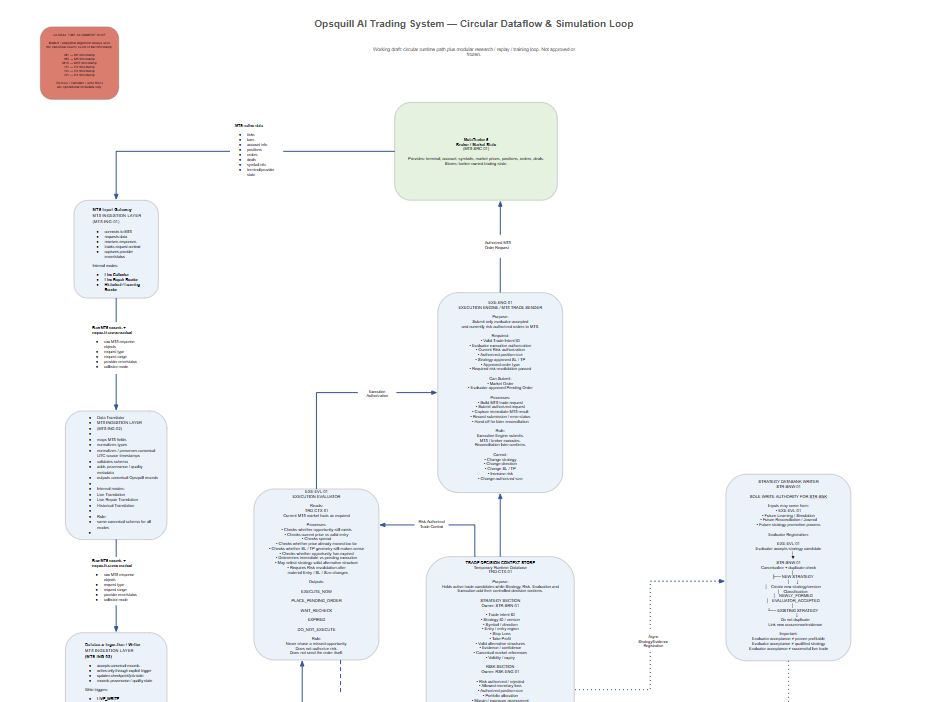
The intended discussion examines how information becomes a proposal, why financial risk requires independent authorization, what can change between a decision and its execution, and why confirmed outcomes matter more than submitted instructions.
It also considers the costs of additional safeguards, the usefulness of deliberately refusing action, and the continuing role of human judgment in systems that become increasingly automated.
Production Credits
Produced by Opsquill Studio.
Audio conversation generated using Google NotebookLM with AI-generated synthetic hosts.
Based on the Opsquill Studio Note Building Opsquill One Block at a Time: Designing a Trading System That Refuses to Guess.
Original project concept, source material, and editorial direction: Opsquill Studio.
Continue Exploring
Studio Note
Building Opsquill One Block at a Time: Designing a Trading System That Refuses to Guess
An in-progress development note on the architecture I’m building—from MetaTrader 5 data and strategy intelligence to deterministic risk control and, eventually, controlled execution. A trading system can be made to place an order surprisingly quickly. That is also exactly what worries me. Connecting to market data, calculating a few indicators, detecting a condition, and firing a trade is not the hardest part. The harder question is what happens when the system becomes more complicated—and which part is allowed to decide what?
Studio Note
More Information Is Not the Same as Better Judgment
In today's information-rich environment, distinguishing between data collection and comprehension is vital. Different sources may offer conflicting perspectives, complicating decision-making. Trusting confident assertions can lead to flawed conclusions, emphasizing the need for critical reflection and sometimes delaying action. Effective decision-making balances human insight with machine intelligence for clarity and accuracy.
Listen
Where Drafting Ends and Engineering Begins
How much technical authority should come with experience? This Opsquill Studio Debate explores whether experienced drafters should think more like engineers—or whether technical contribution must remain separate from final design authority. It examines judgment, accountability, unclear…